Enjoy 10% OFF your next purchase with "SAVE10"
About the Author: The CheatService tactical team maps out massive shooter environments to calculate loot density, rotation timings, and topographical advantages. We analyze spawn algorithms so you never drop blind. Last updated: June 17, 2026 (Updated for Season 3: Blastpoint).
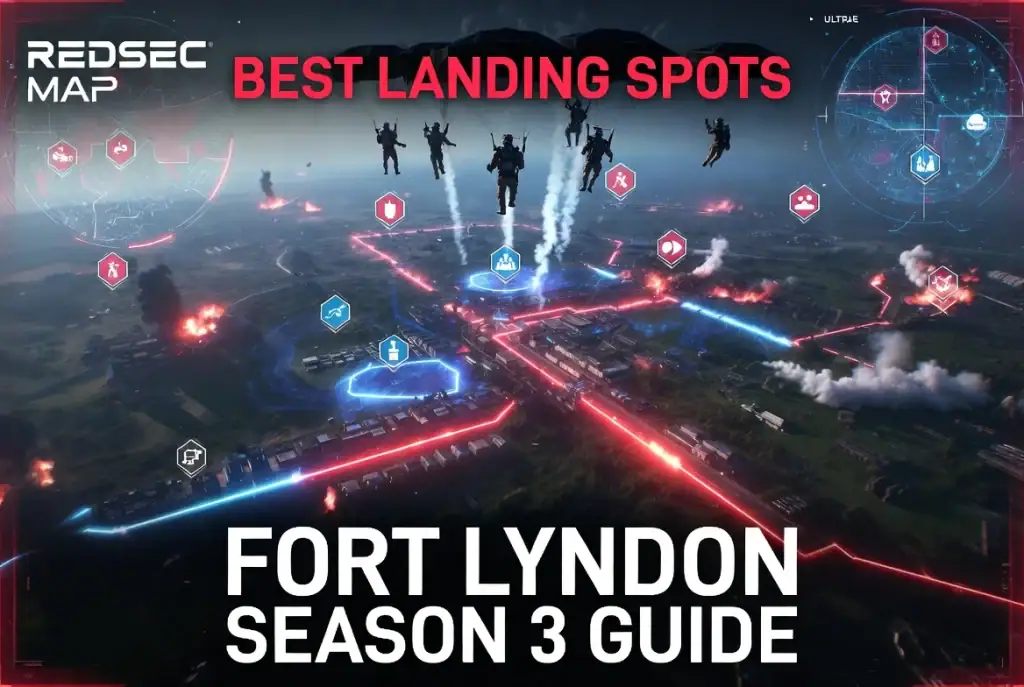
Finding the redsec map best landing spots dictates the pacing and survival probability of your entire match. Fort Lyndon is REDSEC's primary map, officially billed by EA as the largest environment ever constructed for a Battlefield title. Set in a fictional, war-torn Southern California sector, it demands a calculated drop strategy. Aggressive squads should target high-density urban centers like Downtown for maximum loot, while newer players must prioritize isolated perimeter drops like Area 22B to guarantee early survival and uncontested loadout acquisition.
Before selecting a drop zone, you must understand the airborne insertion mechanics. The designated Squad Leader controls the primary jump trajectory, but individual teammates can manually break away to hit adjacent buildings. Your parachute auto-deploys in extreme proximity to the ground. You hit the dirt equipped only with a severely underpowered sidearm; securing a primary weapon within the first five seconds is your absolute priority.
If you are entirely unfamiliar with the overarching platform structure, review our What is REDSEC overview to understand the core game engine.
Loot in Fort Lyndon is scattered across floor spawns and specific equipment crates. Green crates yield Common gear, while Red-and-Black crates hold Rare, fully kitted weaponry. The most valuable containers are Class Chests, which contain algorithms heavily biased toward dropping specific utility gadgets corresponding to the class of the player who opens them.
The Season 3 Blastpoint update radically altered early-game pacing with two new mechanics. First, random POIs are now designated as High Value Zones (HVZs) at the start of the match. Crates in these zones feature glowing blue or green outlines, guaranteeing top-tier armaments but instantly attracting multi-squad firefights. Second, upon initial deployment or resuscitation, players receive an 80-second "Loot Detection" buff that highlights all containers within a 50-meter radius directly through solid walls.
Fort Lyndon is massive. Selecting your drop depends entirely on your squad's mechanical confidence and chosen loadouts. If you are refining your baseline sensitivity and want to compare Battlefield 6 hack packages, mastering these topographical zones is the mandatory first step to actualizing those tools.
The western perimeter of Fort Lyndon is an urban labyrinth. Dropping here requires flawless close-quarters execution. You must land fast, secure a building, and hold the stairwells.
For squads prioritizing intelligent pathing and high-tier military equipment without the unpredictability of Downtown, the map's outer perimeter provides optimal deployment vectors.
Map control often dictates the late game. Identifying key topographical advantages allows you to dictate the engagement range.
| Point of Interest (POI) | Risk Level | Primary Tactical Advantage |
|---|---|---|
| Downtown | Extreme | Massive loot volume; high verticality for Assualt flanks. |
| Defense Testing Complex 3 | High | Central map control; heavily fortified defensive structures. |
| Area 22B | Low | Guaranteed Class Crates; highly isolated with vehicle spawns. |
| Marina | Low | Safe watercraft rotations bypassing central land choke points. |
| Radar Site | Medium | Highest elevation on the map; dedicated sniper optic spawns. |
Your drop location is only valuable if you survive the mid-game. REDSEC handles zone progression differently than other titles. The closing ring—officially dubbed the "Circle of Death"—is not a standard chip-damage mechanic. It is a towering wall of fire that inflicts near-instant lethal damage upon contact.
You cannot stock up on medical supplies and hide inside the gas. You must respect the red zone on your minimap and the red-skull distance indicator on your primary HUD. Rotate early. Utilize ATVs, transport trucks, or the tactical boats at the Marina to secure positioning inside the next ring before the firestorm forces you into a choke point.
During these rotations, engage with in-match Contracts, specifically Data Extraction missions. Completing these side-objectives rewards your squad with high-tier loot drops and massive XP bonuses, ensuring you hit the late game fully kitted. This proactive macro-strategy mirrors the aggressive, objective-focused pacing required to win the REDSEC Gauntlet tournament.
To ensure your weapons are optimized for these diverse engagement ranges, structure your primary and secondary weapon pools using our REDSEC loadout guide before queuing into Fort Lyndon.
Downtown and the Boutique District are the premier hot drops. The extreme density of multistory buildings, shattered storefronts, and guaranteed floor loot force immediate, chaotic close-quarters combat against multiple squads.
Class Chests utilize a smart-loot algorithm. The game registers which class (Assault, Engineer, Support, or Recon) interacts with the crate and heavily biases the dropped utility gadgets and weapon modifications to suit that specific operative's role.
No. The REDSEC ring is a lethal firestorm, not a slow-ticking gas cloud. Touching the barrier results in near-instant death. You must utilize the HUD's red-skull distance tracker and rotate well before the zone collapses.
Mastering Fort Lyndon requires topographical intelligence. Do not blindly follow the jumpmaster into Downtown if your squad is uncoordinated. Evaluate the flight path, utilize the Season 3 Loot Detection mechanic to arm yourselves instantly, and plan your rotations around the unforgiving Circle of Death. Whether you hold the high ground at the Radar Site or execute a stealth coastal rotation from the Marina, dictating the terms of the engagement is how you extract a victory.
Share it on:
